A Deep Dive into Multi-Touch Attribution for Ecommerce Sellers
Does email steal sales from advertising? Follow one customer journey and two attribution models to see how channels work together at different stages of conversion.

Why Stream Is Building Multi-Touch Attribution
While working with clients, Stream often runs into a recurring question: does email end up stealing sales that should be credited to ad channels?
Behind that question lie even more sensitive ones: how much incremental revenue does email actually drive, and could it distort the performance metrics of media buyers or operations teams? Answering this is not just about proving whether Stream delivers value. It requires understanding the relationships, contributions, and goal-setting across every channel. That is the core challenge of marketing and operations for ecommerce sellers: multi-touch attribution.
The shopping journey on an ecommerce site differs from that on a marketplace like Amazon. Ecommerce sellers deal with relatively ambiguous traffic: ads first target a broad interest category, then see who responds.
A Typical Purchase Journey
Imagine Xiao Ming is watching the Olympic opening ceremony on TV and notices that Canadian athletes are wearing Lululemon. That evening, while scrolling through Facebook, he sees an ad for the same down jacket. He clicks the ad, browses the product, and even adds it to his cart, but the price is high, so he does not complete the purchase right away.
The next day, Xiao Ming receives an abandoned-cart recovery email for that jacket. The email offers a new-customer discount of “$50 off orders over $500.” He decides to buy winter clothing that evening. Back home, he searches Google for the Lululemon website, finds the jacket, adds a pair of pants to reach the $500 threshold, and enters the email promo code at checkout to place the order.
This is a typical purchase path for an ecommerce seller. The user does not necessarily know what they want to buy at the start. Brand exposure, a Facebook ad, an email, and a Google search may each move the same purchase forward at different stages.
If you look only at the final interaction, Google search appears to “steal” credit from email; email appears to “steal” credit from the Facebook ad; and Facebook appears to “steal” credit from brand exposure. But remove any single link in that chain, and the purchase might never happen. Without Facebook, the user may never discover the product. Without email, the user may forget about it. Without search, the user may not find a convenient way back to the website.
For discovery-driven shopping, every customer touchpoint is essential. Once a user reveals a preference or a need, the brand must provide enough information and a frictionless path to move the user toward the next step.
Every channel supports the others, and each plays a distinct role at a different stage of conversion.
Stream’s Data: Purchases Rarely Involve Just One Touchpoint
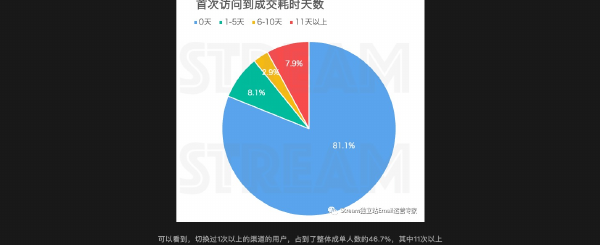
The following data comes from a Stream sample of one million users who visited ecommerce sites between April 1 and April 30, 2022. The charts show the distribution of users by the number of channel visits before purchase, and by the time elapsed from first visit to conversion.
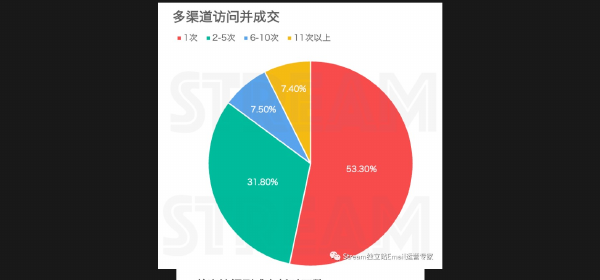
Among users who made a purchase, 46.7% switched channels at least once. Of those, 7.4% visited more than 11 channel touchpoints. Nearly half of all buyers did not convert after a single visit, and roughly 20% needed more than six days to complete a purchase.
This does not mean brands should focus only on multi-channel users, nor does it mean they must push users to buy immediately. Different channels serve different functions within the funnel: some are responsible for inspiration and acquisition, while others capture interest, remind, and bring users back. The job of attribution is to understand those functions, not to let one channel claim all the credit.
What Last Click and First Click Actually Tell You
The two most common attribution models are:
- Last Click attribution assigns 100% of conversion value to the channel responsible for the final interaction before purchase. It tends to highlight channels that work closer to conversion, including re-engagement and return visits.
- First Click attribution assigns 100% of conversion value to the channel responsible for the user’s first interaction. It tends to highlight channels responsible for acquisition and demand generation.
Neither model alone can define a channel’s nature. But comparing a channel’s results under both models helps reveal which end of the journey it leans toward.
When the ratio of “Last Click revenue ÷ First Click revenue” is greater than 1, the channel skews toward pre-purchase re-engagement, return visits, or an assist role. Examples include direct visits, branded search, retargeting ads, and email marketing. When the ratio is less than 1, the channel skews toward acquisition. Examples include Facebook and non-branded Google campaigns.
Attribution Is Not Causality, and It Is Not About Stealing Credit
Some channels do not fit neatly into a single funnel role. In those cases, examine the user journey alongside the channel’s revenue under different models and the specifics of each campaign. Attribution is not meant to declare that “this channel took revenue away from that channel.” It gives teams a view of the real customer journey: which channels drive discovery, which capture intent, and which reduce friction when a user is hesitating.
In Google Analytics’ multi-touch attribution reports, teams can first examine how each channel differs across models, then interpret those differences in light of specific campaigns, audiences, landing pages, and email strategies. For example, when non-branded Google campaigns show higher revenue under First Click attribution than under Last Click, the channel behaves more like an acquisition source. When Stream email accounts for a higher share under Last Click attribution, it is often re-engaging users who have already shown interest.
This does not mean one channel “stole” volume from another. It means they play different roles along the same path. Multi-channel relationships are not causal substitutes; they coordinate toward a shared goal. From the user’s perspective, a purchase often goes through “see, understand, compare, return, buy.” The brand’s job is to use channels and content to steadily reduce friction at each step.
A Final Note: Put Attribution Back Into the Customer Journey
The original analysis was published in May 2022. At that time, changes to third-party cookies, IDFA, and platform attribution capabilities were already making it harder for any single platform to build a complete picture of a user. That context still carries a reminder today: do not view ads, email, search, or brand touchpoints in isolation.
Stream provides email marketing and automation capabilities that help brands stay relevant after users leave the site. It does not replace acquisition channels. A more sensible approach is to combine multi-touch attribution, behavioral paths, and business objectives to continuously improve overall acquisition and conversion efficiency.