What Is an AppLovin Interactive Page? A Guide for Ecommerce Brands
An AppLovin ad does not end with the video. Learn how the post-video Interactive Page turns attention into a click, and why the landing page must continue the same product and offer.
When ecommerce brands begin testing AppLovin, the video usually gets most of the attention. Teams refine the first three seconds, the product demonstration, the offer, and the final beat over and over. The screen that appears after the video is often treated as an afterthought.
But the ad does not end when the video stops. A shopper may have just become interested in the product, only to see a vague brand image, a different offer, or no clear reason to take the next step. The interest built by the video can disappear before the click.
AppLovin calls this post-video screen an Interactive Page, or AIP. If the platform names are still confusing, start with our explanation of AppLovin Ads, Axon, and MAX.
An Interactive Page is a second moment of persuasion
AppLovin defines the Interactive Page as a mini landing page inside the ad. It appears after the video while the user is still in the mobile-game ad environment. Only after the user clicks does the brand's ecommerce site open.
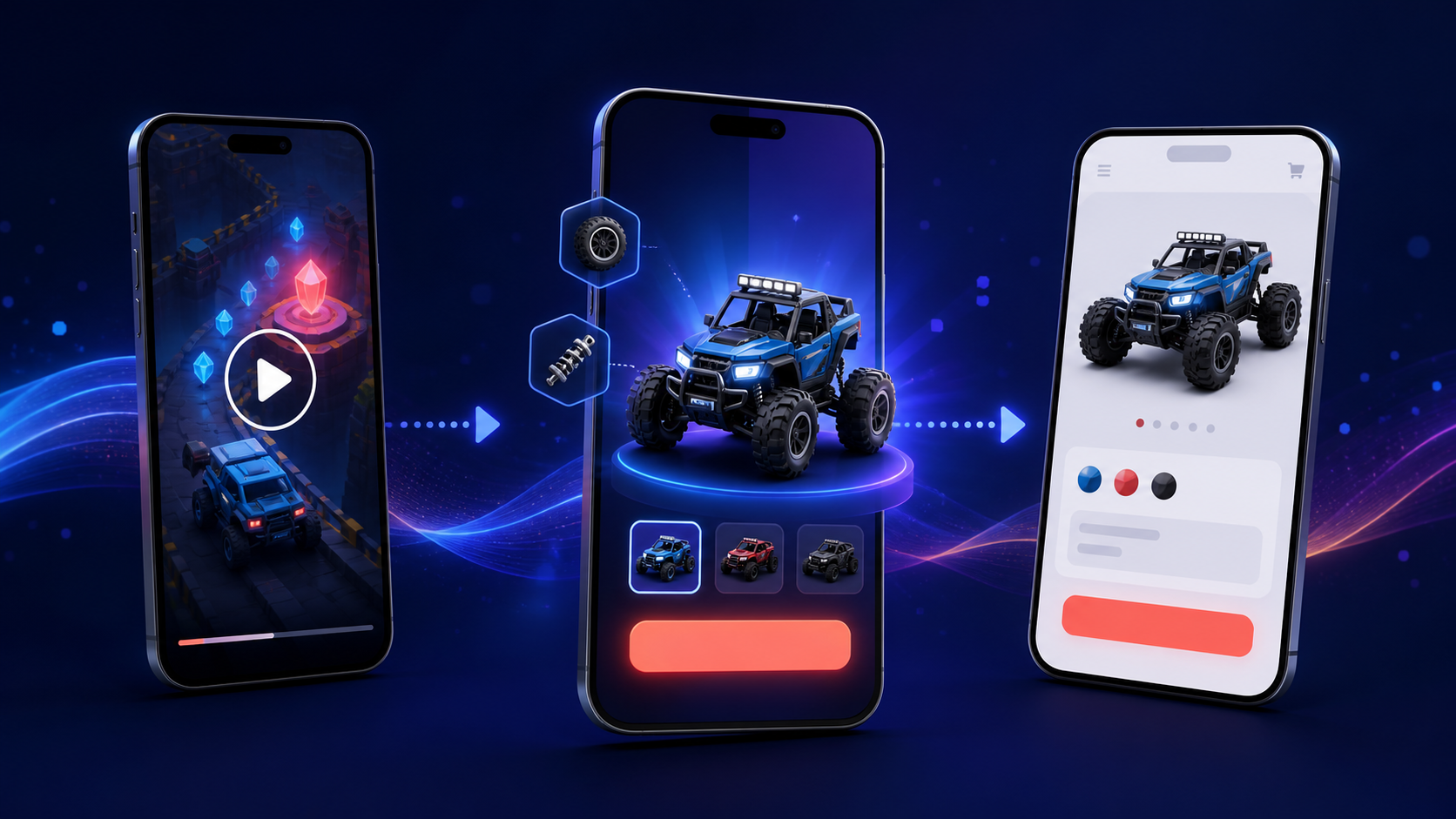
A typical ecommerce ad experience can be understood as:
Portrait video → Interactive Page → Dynamic Catalog → brand website
Dynamic Catalog depends on the campaign setup, but the jobs of the components are distinct. The video creates interest and tells the product story. The Interactive Page reinforces the product, offer, and reason to act. Dynamic Catalog can surface products that are more relevant to the individual user. The brand website then carries the product details, promotion, and purchase experience.
The Interactive Page is therefore more than an image attached to the end of a video. It gives the ad a second opportunity to persuade: the video helps someone think, "This could be for me," and the Interactive Page answers, "Why should I click now?"
Three concepts that are easy to confuse
The first distinction is between an Interactive Page and the brand landing page. The Interactive Page still belongs to the AppLovin ad experience. The page that opens after the click belongs to the brand. Treating them as the same thing makes it easy for the product or promotion in the ad to become disconnected from the post-click experience.
Second, an Interactive Page is not a Dynamic Catalog. The Interactive Page reinforces the value and action behind the specific creative. Dynamic Catalog is a separate product-discovery component that follows it. The two can work together, but they are not interchangeable.
Third, "Interactive" does not mean every page must be a complex playable. AppLovin currently supports AI-generated pages, custom work produced through AppLovin Creative Studio, and existing 9:16 image assets to which the platform adds a call to action.
The real challenge is not building elaborate interaction. It is treating the post-video screen as a conversion step with its own message and purpose.
Why the Interactive Page deserves dedicated attention
AppLovin currently states that Interactive Pages can contribute more than 50% of the clicks within a creative set. That boundary matters: it is AppLovin's description of contribution within a creative set, not a guaranteed result for every campaign.
Even without relying on that number, the role is clear. The video determines whether someone keeps watching. The Interactive Page helps determine whether that attention turns into a click. A strong video followed by a generic logo and a vague "Shop now" can waste the final moment of intent.
AppLovin's examples include promotions and scarcity, key product advantages, reviews or media recognition, before-and-after demonstrations, and comparisons with alternatives. These are not mandatory templates, and not every Interactive Page needs an aggressive discount. They share one principle: while interest is still warm, give the user a concrete reason to click that remains consistent with the video.
The strongest pages continue the same product and offer
The most common problem is not unattractive design. It is discontinuity. The video demonstrates one product while the Interactive Page only talks about the brand. The Interactive Page promises a discount that the shopper cannot find after the click. The creative features one item, but the click opens a broad collection page that requires another search.
Every additional search or reinterpretation uses up some of the interest the ad just created. In our campaign work, we therefore pay close attention to whether the offer is attached to the product the shopper has just seen, and whether the same product, benefit, and promotion remain visible on the brand website.
An Interactive Page is not an isolated poster. It is the bridge between the video and the store. A visually impressive bridge still fails if its two ends do not connect.
The journey continues after the click
To address this gap, Fintouch has developed an AppLovin-ready landing-page experience for spend-threshold gift-with-purchase offers: the familiar “Spend $X and get a free gift” promotion. It keeps the featured product and offer visible after the click. Along the shopper journey, Boost handles the post-click landing-page experience, Fintouch supports personalized on-site promotions, and Stream continues the conversation through lifecycle email. Each product addresses a different point where the same visit can lose continuity.
Actual results still depend on the strength of the offer, product fit, and the on-site experience. Message continuity does not guarantee a conversion lift. It solves a more basic problem first: do not let the interest created by the video disappear between the ad and the store.
Source: AppLovin Support Center, Ad Format