Why Subscription Pop-ups Matter for Ecommerce Stores
Subscription pop-ups help capture the traffic you already paid for. See how Stream expands the reachable audience for follow-up email.
There is no shortage of information about subscription pop-ups for ecommerce stores. Yet very few explanations answer the basic question clearly: why should a store turn one on, and what does it actually change? This article explains the full logic in one place.
The first job of a subscription pop-up is to capture intent while it is fresh
Advertising traffic is often compared to running water. It carries demand that is real but constantly moving. Out of every 100 people who reach an ecommerce landing page, perhaps 30 to 50 will view a product, 15 to 20 will add something to their cart, 2 to 6 will begin checkout, and only 1 to 3 will ultimately place an order.
The most important job of a subscription pop-up is to catch the people in that funnel who have already shown interest but are not yet ready to buy.
Consider the same funnel using the top end of those ranges. Out of 100 paid visitors, 50 view a product, 20 add a product to their cart, 6 begin checkout, and 3 complete a purchase.
Without a subscription pop-up, the store may capture only three or four email addresses. Even among the six people who begin checkout, not everyone enters contact information and proceeds to payment.
Once subscription pop-ups are active, the picture changes. A store might capture 5 to 10 subscribers among the 50 product viewers, another 5 or so among the 20 cart users, and then 3 to 4 email addresses during checkout and purchase. That leaves the store with roughly 19 people it can continue to reach, about five times as many as it would capture without pop-ups.
The second job is to capture demand that converts later
Even the most precisely targeted advertising cannot make every purchase happen immediately. Let us look at one set of data.
The chart below shows the time between first advertising visit and first purchase for apparel store A. Its products average $20 to $30 per item, and its average order value is $40 to $60.
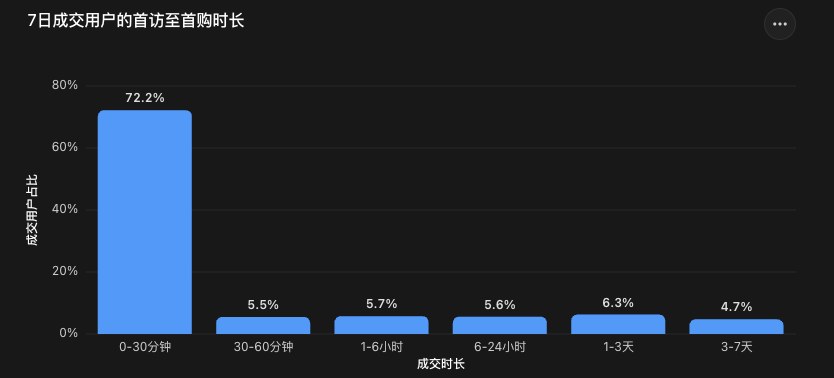
Seventy-two percent of conversions happened within 30 minutes of the visitor arriving from the channel. The remaining 28% happened later than 30 minutes, and some orders still appeared three to seven days afterward.
That delayed conversion window is often where an ecommerce store's profit or loss is decided. Facebook already prices in much of the revenue it expects you to earn immediately. It is not going to leave an extra margin on the table for free. (Yes, that hurts.)
Email plays an extremely important role across the medium and longer conversion window. Even an inexpensive retargeting campaign can cost at least $1 per click, and Facebook traffic for many older audiences already reaches a CPC of $2. That is expensive.
Advertising often runs at a ROAS of only 1.5 to 2. By comparison, email win-back economics can be dramatically stronger. Email marketing commonly reaches a ROAS of 20 to 50, making it 10 to 30 times less expensive than paid advertising.
Around 2020, Facebook still offered enough of a traffic advantage that many sellers did not pay much attention to email. Today, Facebook prices are fiercely competitive. Sellers now scrutinize every stage of the ecommerce conversion path, and the subscription pop-up is the entry point to the entire email program.
Over seven years, Stream and Fintouch have served more than 10,000 ecommerce sellers. Through extensive practical work with sellers, we developed a high-converting pop-up system. Repeated A/B tests then helped us turn that experience into a complete set of subscription strategies with email capture rates well above ordinary benchmarks. Here is how the system works.
Stream is our ready-to-run email revenue solution for ecommerce stores, so the full subscription pop-up system is built into the product as a strategy:

Stream's subscription system is not a single pop-up. It combines two pop-ups with two sets of state checks, all designed around the customer journey.
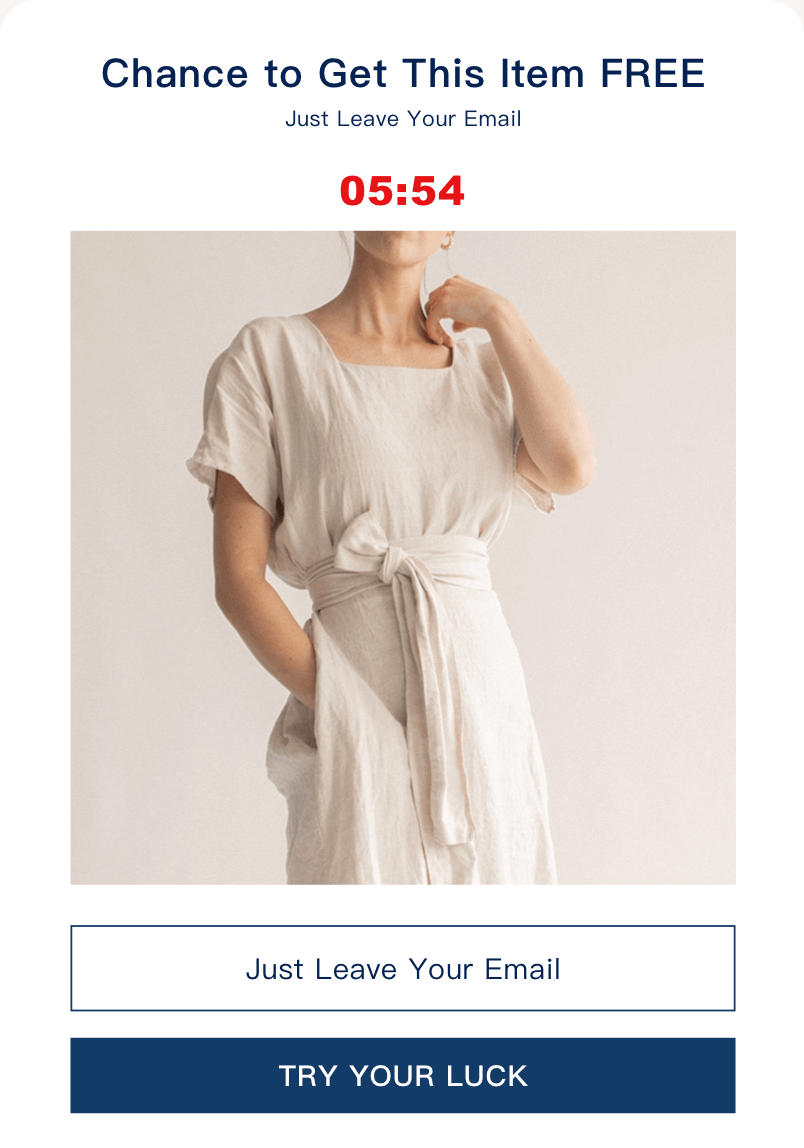
The first is a new-visitor subscription pop-up for customers whose intent is not yet clear. Its key idea is to delay the reward. A relevant offer is exchanged for permission to continue reaching the visitor. If the visitor closes the pop-up, the system performs its first state check and keeps an entry icon for the offer visible on the page.
The next critical moment arrives as the customer moves further through the shopping journey and adds a product to the cart.
This is where the strongest hook becomes available. Cart users are the people showing the strongest immediate demand. At that moment, the store should offer a relevant incentive in exchange for permission to stay in touch. If the offer is set appropriately, it can lift the subscription rate substantially.
If the customer still does not subscribe, the system performs a second state check and preserves an entry icon for the cart offer.
Across the entire journey, Stream's pop-up system follows customer behavior. It aims to avoid unnecessary interruption while capturing as many high-intent subscribers as possible.
An ordinary subscription pop-up often captures about 3% of visitors. With Stream's combined system, the new-visitor pop-up can capture 3% to 5%, while the cart subscription pop-up can capture 10% to 20% of the relevant audience. The entire system becomes available simply by turning on Stream's pop-up strategy.
Stream pop-ups on versus off: how different can the result be?
The sections above explain the logic. Now let us calculate the practical effect with real data.
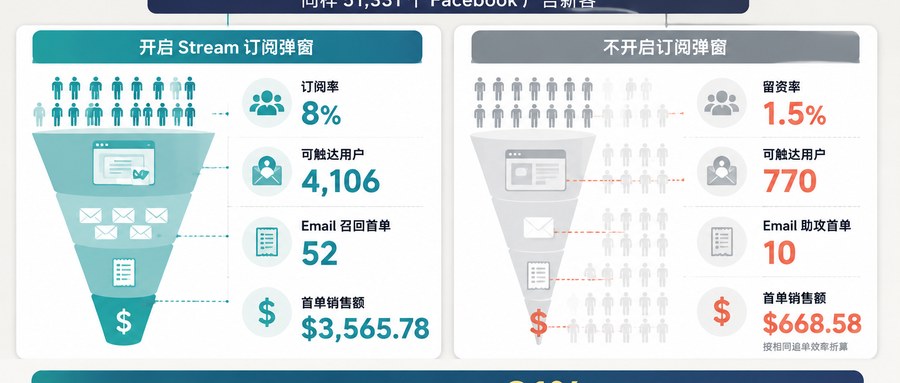
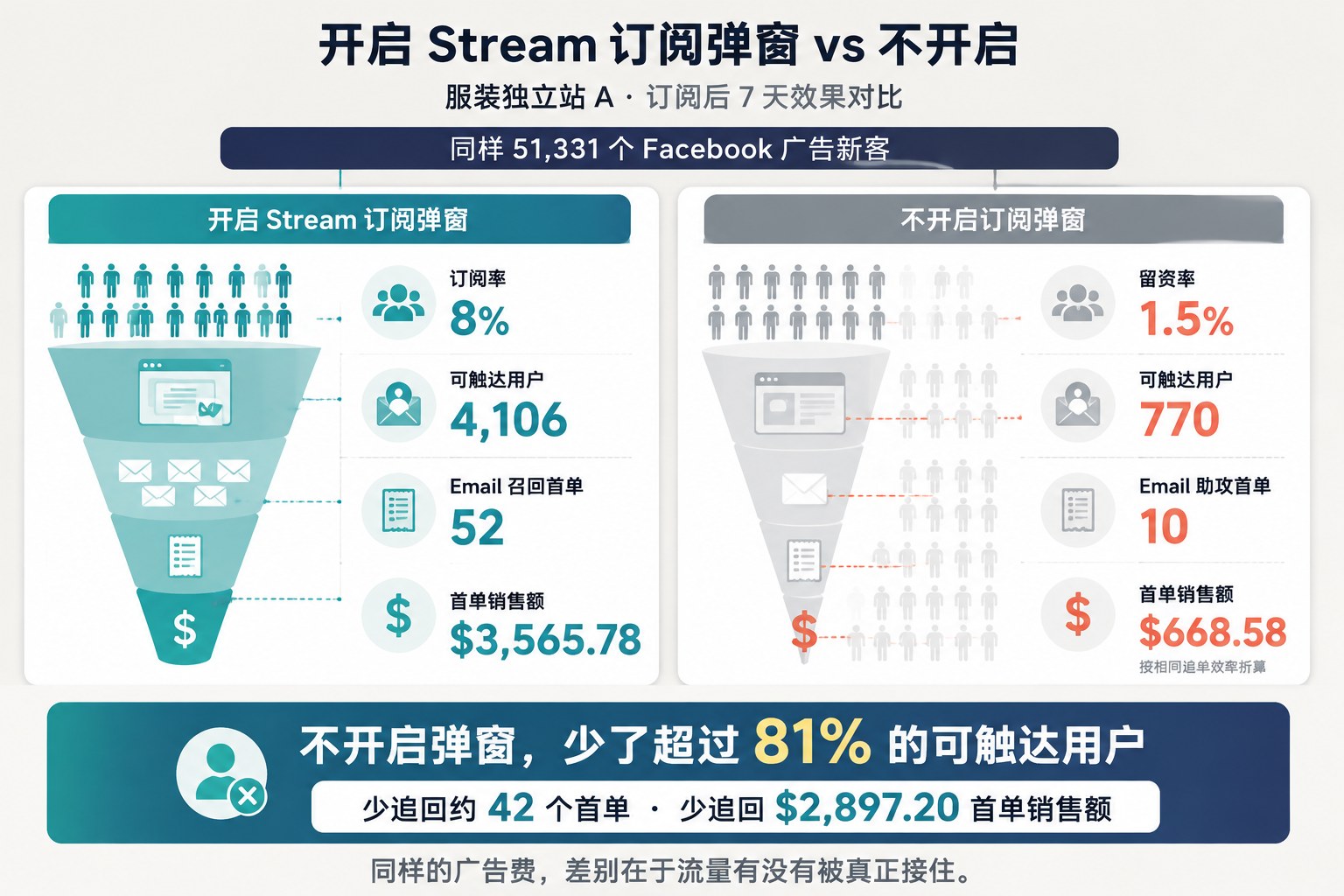
Return to apparel store A. Suppose Facebook advertising brought 51,331 new unique visitors to the store in July. With Stream subscription pop-ups enabled and an 8% subscription rate, the store would retain about 4,106 subscribers. During the seven days after subscribing, Stream's email win-back activity assisted 52 first orders and $3,565.78 in first-order revenue from those people.
Without subscription pop-ups, the store would depend on checkout and similar steps to collect contact information. At a 1.5% capture rate, the same 51,331 new advertising visitors would leave only about 770 reachable users. Applying the same follow-up efficiency, that audience would produce roughly 10 first orders with identifiable email assistance and $668.58 in first-order revenue. Compared with the enabled scenario, the reachable audience would be more than 81% smaller, and the recoverable first-order revenue would fall by a similar proportion.
Put the two outcomes side by side and the gap is obvious. With the same advertising traffic and the same advertising spend, enabling Stream's subscription pop-ups produces about 3,337 more people the store can continue to reach, about 42 more first orders, and $2,897.20 more in first-order revenue. The difference is not at the advertising platform. It is whether the traffic that the store already paid for is actually captured after arrival. For many stores, that difference can determine whether the economics work.
Ultimately, this reflects two fundamentally different attitudes toward traffic
As advertising becomes more expensive, ecommerce competition is no longer only about getting people to the site. Whether each visit becomes a one-time expense or a customer relationship that can continue determines how far the same advertising budget can go.
A subscription pop-up is not simply a feature that a store may or may not install. It is a dividing line. On one side, a store pays real money for a visitor who leaves after one session, and the next interaction depends on the customer returning voluntarily or the store paying to reach them again. On the other side, the store pays the same amount to acquire the visit but can continue the conversation through email after the visitor leaves, nurturing and winning back demand that converts days or even weeks later. Stream's role is to preserve that connection at the moments when visitor intent is strongest, so demand does not disappear when the page closes.
Real ecommerce growth is not only about buying more traffic. It is also about refusing to let the traffic you already bought disappear.
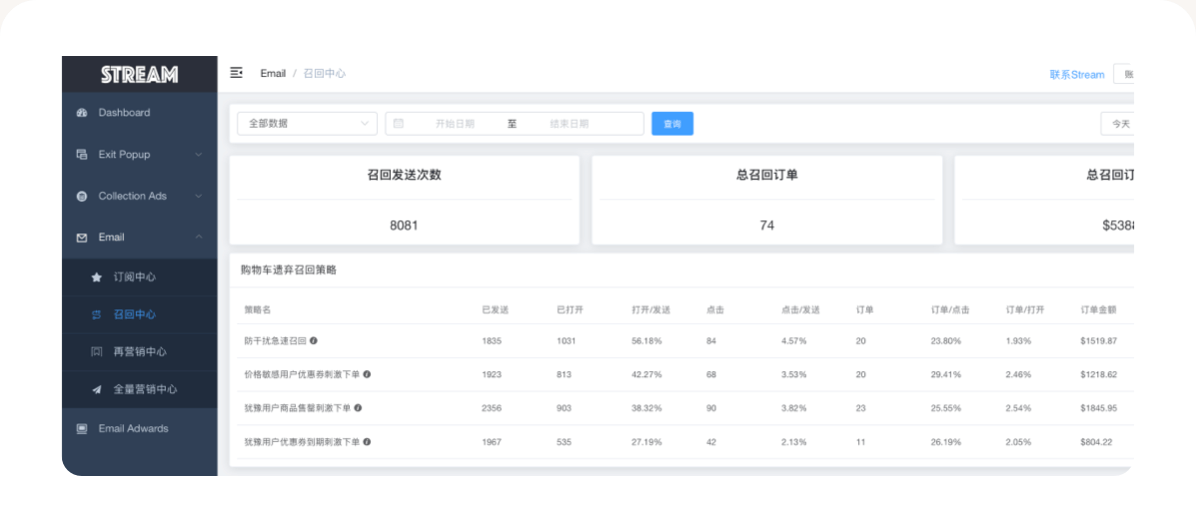
Capturing the subscriber is only the first step. Next, learn how triggered email can maximize ecommerce conversion recovery.
To see why this becomes more strategically important as advertising platforms automate, continue with When Facebook Takes the Wheel, What Advantage Is Left for Ecommerce Sellers?.
Updated Aug 28, 2026