When Facebook Takes the Wheel, What Advantage Is Left for Ecommerce Sellers?
As ad platforms automate more execution, durable advantage moves outside the account: products, on-site conversion, and first-party customer relationships that compound.

Advertising is becoming less of a manual craft and more of an automated operating system.
That does not mean Facebook no longer matters. It does not mean paid acquisition matters less. Traffic remains essential to ecommerce.
What has changed is the platform itself. The cockpit is moving closer to self-driving.
Meta's Andromeda makes ad retrieval and personalization more dependent on machine learning in support of Advantage+ automation. Google Performance Max applies AI to bidding, budget optimization, audiences, creative, and attribution. AppLovin Ads asks advertisers to set return targets while Axon searches for people more likely to buy, with more of the creative process becoming automated as well.
The advertiser still sets the direction: what to sell, how much to spend, which creative to supply, and which commercial outcome to pursue.
But there are fewer knobs left on the dashboard.
More teams now give similar systems the same basic inputs: goals, products, creative, and data. Techniques that once lived inside a media buyer's account are becoming standard platform capabilities.
When everyone can buy the same capability from the platform, it becomes harder to sustain as a competitive moat.
Product advantage is the foundation, but it can be chased
An ecommerce business still needs a strong product. That foundation comes first.
Some products build real depth. Patents accumulate, R&D compounds, supply chains improve, and brands earn durable recognition. Those advantages deserve long-term investment.
For many sellers, however, product advantage fades with time.
Competitors copy winning products, audiences tire, and categories become crowded. Once a platform scales an offer, its demand, pricing, creative approach, and even supply chain can become visible surprisingly quickly.
So what can an ecommerce seller accumulate besides the next product?
What can improve today without resetting tomorrow, becoming more valuable as the customer base and operating history grow?
One answer is email.
The asset worth building is not just traffic, but permission to return
Paid traffic behaves like running water.
Out of 100 paid visitors, perhaps 30 to 50 view a product, 15 to 20 add something to cart, two to six begin checkout, and only one to three complete a purchase.
The rest are not necessarily uninterested. They may be comparing options, hesitating, or planning to buy later.
If they leave without a way to stay in touch, the click disappears. The seller must wait for them to return or pay the platform to reach them again.
That is why subscription pop-ups matter.
A pop-up is not simply another site feature. At a relevant moment of intent, it exchanges a useful offer for permission to continue the conversation. Only then can a one-time paid visit become an ongoing customer relationship.
This is why email is one of the few digital assets an ecommerce seller can build directly.
“Owned” does not mean permanent possession. People can unsubscribe, inbox placement varies, and every program must follow privacy rules. What compounds is permission, customer relationships, and the operating knowledge built around them.
An ad click ends when it is used. Those assets do not reset at the end of the day.
Email needs to capture two waves of demand
Inside Stream, we describe email as supporting two waves.
The first wave returns demand to where it came from.
A shopper clicks an ad, views a product, adds it to the cart, and leaves before buying. Email should follow the behavior before attention disappears and restore the original path to purchase.
The four clearest opportunities are a product view without a cart, a cart without checkout, an unfinished checkout, and an additional offer after purchase.
Recovery should not begin too quickly.
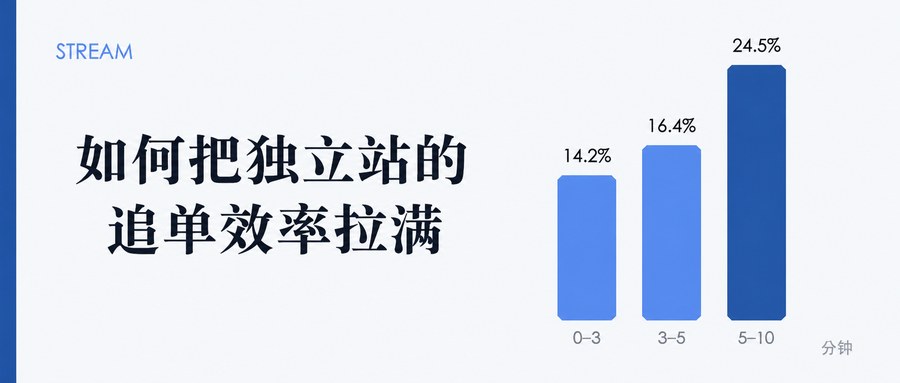
In one Stream cohort of customers who purchased in July 2026, 55.2% completed their first purchase within ten minutes of the first observable Facebook-referred product visit. The cumulative share reached 75.7% within 30 minutes, while 4.2% still purchased between days three and seven.
That distribution does not prove how much incremental revenue email created. It shows that some demand resolves later than the first visit.
For this type of paid-traffic journey, Stream's default starting point is to protect the active shopping window. If a customer has viewed or added a product but still has not purchased ten minutes later, behavior-triggered recovery can begin.
A recovery email has two jobs: preserve the record and restore the path.
A product view is a light form of saving. An add-to-cart action expresses stronger intent. Email remembers what the customer viewed or added and gives them a direct route back.
The second wave creates a new visit.
When subscribers are no longer returning on their own, campaigns featuring products, promotions, and useful content can reactivate demand and create another opportunity to buy.
The first wave captures demand that advertising just created. The second keeps an established customer relationship productive.
One makes the current ad budget travel further. The other gives past traffic another chance to create value.
A campaign is not the end; it starts the next recovery cycle
Many teams treat email marketing as a calendar of campaigns.
The deeper value is that campaigns create fresh clicks, product views, carts, and checkouts. Those behaviors can feed back into triggered recovery.
The loop looks like this:
Advertising creates the first demand -> subscription pop-ups capture permission -> triggered email follows up on paid traffic -> the subscriber base receives campaigns -> campaigns create new behavior -> new behavior enters triggered recovery.
Once this system keeps running, email is more than a sending channel. It becomes a small demand engine built on first-party customer relationships.
That is also why email can stabilize ecommerce growth. It captures more value when paid traffic surges and keeps working with the audience already built when traffic slows.
The same traffic can produce two different outcomes
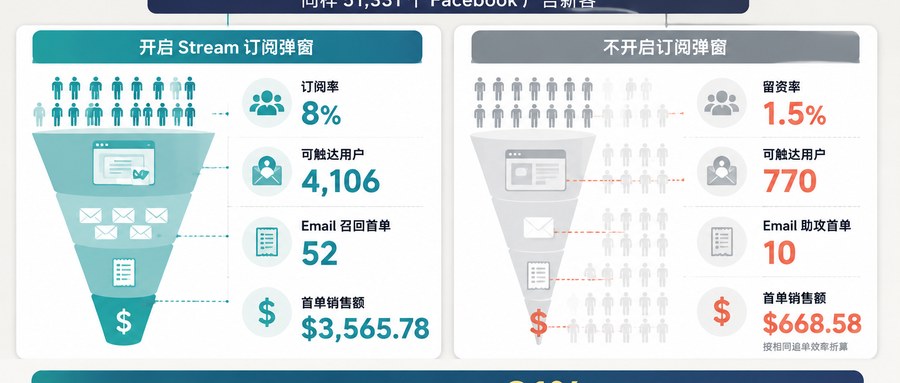
In the apparel example behind this article, 51,331 new Facebook visitors produced an estimated 4,106 subscribers at an 8% subscription rate. Within seven days of subscribing, those people generated 52 first orders with identifiable Stream email assistance and $3,565.78 in first-order revenue.
For comparison, a 1.5% passive contact-capture assumption leaves about 770 reachable customers. Applying the same follow-up efficiency produces a modeled result of roughly ten first orders and $668.58 in first-order revenue.
The difference is about 3,337 reachable customers, 42 first orders, and $2,897.20 in first-order revenue.
This is not a randomized A/B test. It does make the strategic point visible: the gap may emerge after the click, depending on whether the business preserves a relationship with the traffic it already paid for.
And that is only the first month. The ad spend has already been consumed, while the subscriber relationship can continue to be managed within the customer's permission.
One side is consumption. The other is accumulation. Over time, they become very different businesses.
Stream lowers the difficulty of building this advantage
The idea behind email is simple. Running the system is not.
When should the store ask for an email? Which behavior should trigger a message? Which customer belongs in which strategy? How long should the delay be? What should the message say? Where should the click lead? How should campaign behavior return to recovery flows?
If sellers must research and design every step from scratch, email becomes something they know they should do but never fully operate.
That is the problem Stream is designed to reduce.
Stream is not a blank canvas that asks the seller to draw every workflow. It turns accumulated operating methods into productized starting points: subscription journeys mapped to customer intent, 14 core behavior-triggered strategies, audience segmentation, and automated campaigns.
For example, when a shopper leaves after adding to cart, a Stream email can restore that cart even if the shopper changes devices. The goal is not merely to send another message. It is to return the customer to the purchase journey they did not finish.
The hard part is starting from an empty workflow. Once the method is built into the product, the seller can activate the system, provide the right product and commercial inputs, and keep improving from observed results.
Compared with repeatedly inventing a product moat that competitors cannot copy, email is an advantage that is easier to begin and more capable of compounding over time.
Where will the gap emerge after Facebook takes the wheel?
The next competitive gap in ecommerce will not be only about who buys traffic better. It will be about who can preserve the traffic they buy, keep building the relationship, and leave an asset behind after every acquisition cycle.
As advertising platforms automate more execution, advantage moves outside the ad account: products and brand, creative and content, on-site conversion, first-party customer relationships, and an operating system the business can reuse.
The product determines whether a customer chooses you.
Email helps determine whether someone who already knows you comes back.
The platform is taking more control of the steering wheel in paid media. What happens after the click is still yours to design.
Leave the complexity to Stream, and keep your attention on products, traffic, and the business itself.
Explore the Stream lifecycle email loop
Evidence notes
- Meta Andromeda is one retrieval and personalization system supporting Advantage+ automation. Google Performance Max and AppLovin Ads / Axon also expand the role of AI in campaign and creative execution. A shrinking manual-operations advantage does not mean advertisers have no control.
- The purchase-timing data comes from a Stream aggregate cohort for July 2026: the first observable product landing page contained an
fbclid, the customer completed a first purchase within seven days, and the analysis used a 20% reproducible deterministic sample. It is a time distribution among customers who purchased, not a causal estimate of incremental email revenue. Ten minutes is Stream's default starting point for this journey, not a universal optimum. - In the apparel example, 52 first orders and $3,565.78 in first-order revenue come from the 8% subscription side described in the source article. The 1.5% contact-capture side and its downstream results are a modeled scenario using the same follow-up efficiency, not a randomized A/B control.
- An email list and customer relationship are first-party assets that remain subject to permission, unsubscribes, deliverability, privacy rules, and content quality. This article does not promise fixed revenue, ROI, or an order from every cycle.