How to Maximize Ecommerce Conversion Recovery
Use time-to-purchase data to decide when triggered email should begin, then see how behavior recovery, cross-device carts, and personalized destinations preserve demand.
Most ecommerce operations advice focuses on how to build triggered email sequences, write welcome emails, or configure a Klaviyo Flow.
Those topics matter, but they often miss the first commercial purpose of triggered email: recovering demand that would otherwise leave the store without an order.
When paid-media ROAS may be only 1.5 to 2, a vague discussion about "humanized engagement" does not reach the core problem. Triggered email needs to improve conversion recovery.
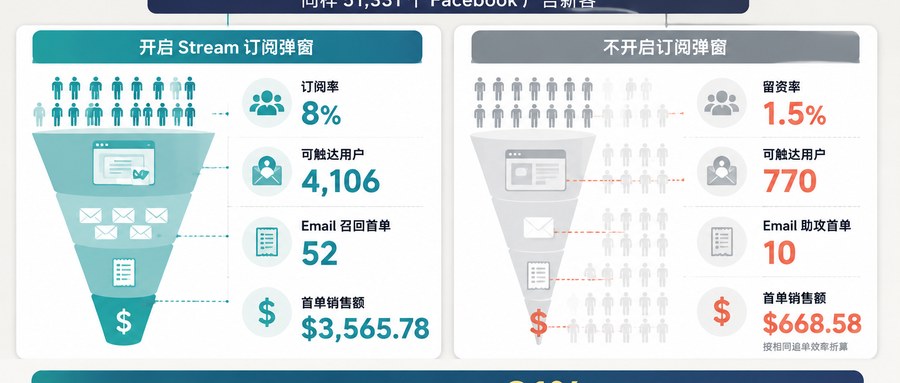
Why triggered email can directly improve conversion recovery
In Why subscription pop-ups matter for ecommerce stores, we shared a useful distribution: among customers who completed a first purchase within seven days, 75.7% converted within 30 minutes of landing from the channel. The remaining 24.3% converted later, including purchases three to seven days after the visit.
That delayed conversion window can sit directly on the profit line for an ecommerce seller.
The journey is easy to describe:
Paid visitor -> product view -> add to cart -> checkout -> payment
At every step, some customers stop. Each stop creates a recovery opportunity:
- Product viewed but not added to cart
- Product added but checkout not started
- Checkout started but payment not completed
- Purchase completed with an opportunity for an additional offer
Advertising platforms pursue the same broad idea by bringing prospecting and remarketing closer together. Email, with SMS as a companion channel, is one of the few direct customer relationships that the seller actually owns.
Those four behavior stages form the core triggered recovery sequence.
Why we do not lead with a welcome email
Most email platforms treat a welcome email as a required automation. We are more cautious, not because a welcome email is inherently wrong, but because its timing can interfere with the most expensive traffic on the site.
For a paid-traffic-led store, a customer who clicks an ad often arrives with active purchase intent. When that customer submits an email through a subscription pop-up, the immediate purpose may be to receive a coupon for the purchase already in progress, not to begin a long-term brand relationship.
If a welcome email immediately introduces an even larger discount, it can interrupt checkout, pull attention back to the inbox, or teach the customer to wait for a better code.
That attention was purchased. The timing deserves the same discipline as the message.
So when should recovery begin? The data gives us a useful boundary.
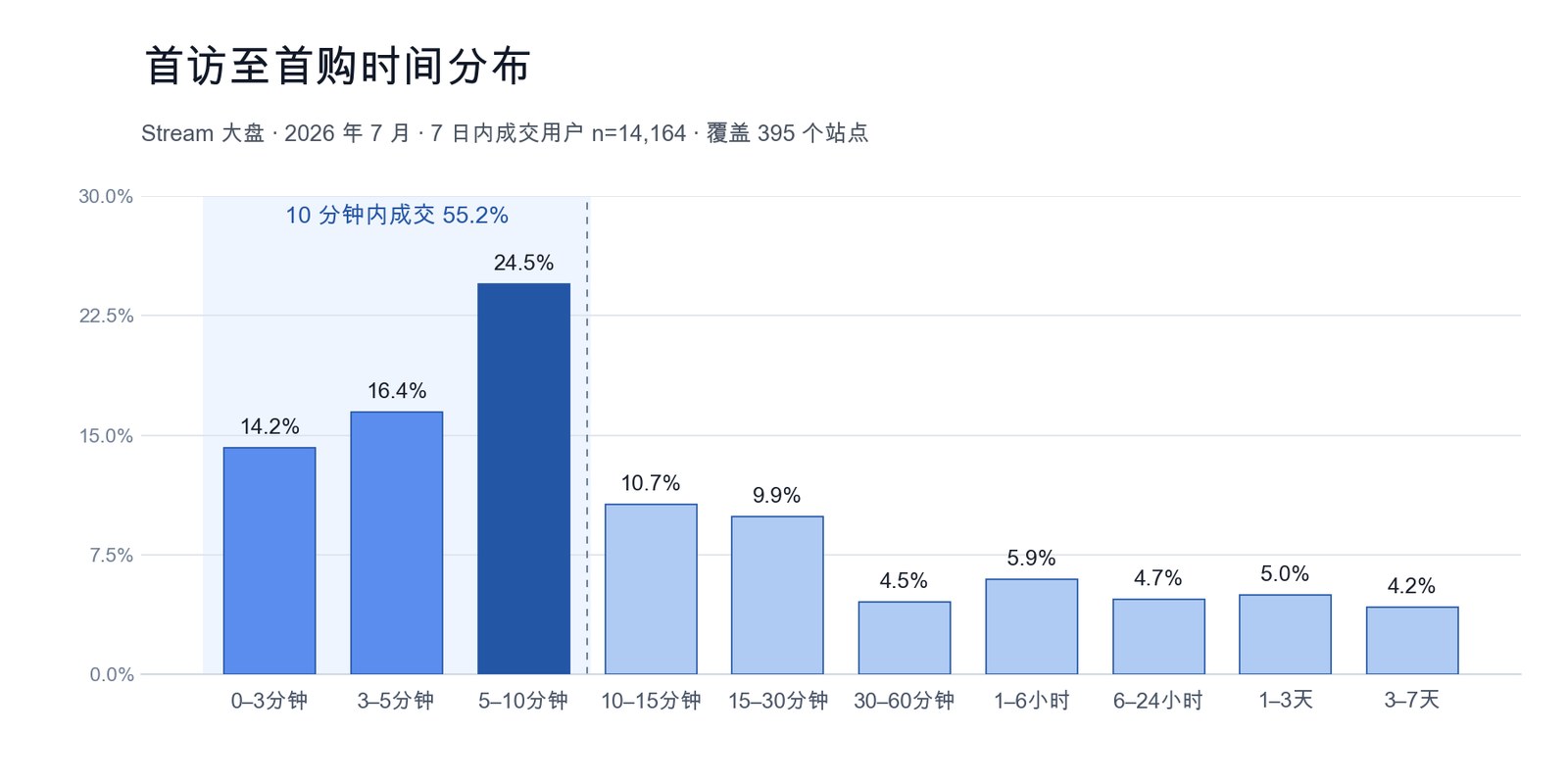
Sample: Stream aggregate data for July 2026. The first observable product landing page contained an fbclid, the customer completed a first purchase within seven days, and the chart uses a 20% reproducible deterministic sample.
Among customers in this completed-purchase cohort:
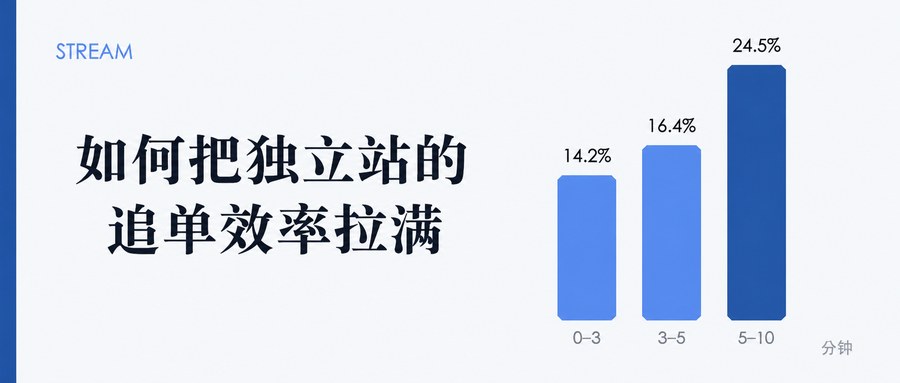
- The largest interval was not the first instant after arrival. It was minutes five through ten, accounting for 24.5% of purchases.
- The first ten minutes accounted for 55.2%, and the first 30 minutes accounted for 75.7%.
- The share declined after ten minutes, but 4.2% of purchases still occurred between days three and seven.
The operating approach follows from that distribution:
1. Protect the high-intent window. During the first ten minutes after arrival, avoid welcome messages that pull an active shopper away from the journey already in progress.
2. Begin behavior-triggered recovery after the window. When a customer has viewed or added a product but still has not purchased, email can help rather than interrupt.
Our default starting point is therefore ten minutes after the relevant behavior. It is a starting policy, not a universal optimum for every store.
In short:
- Fast converters with active intent: reduce interruptions
- Customers still comparing products: follow up promptly
The two jobs of a recovery email
For a hesitant shopper, the email should do two things.
1. Preserve the record. Show what the customer viewed or added.
2. Restore the path. Give the customer a direct way back to the relevant products.
A product view is a light form of saving. An add-to-cart action expresses stronger intent. Email is well suited to summarizing both and making them recoverable later.
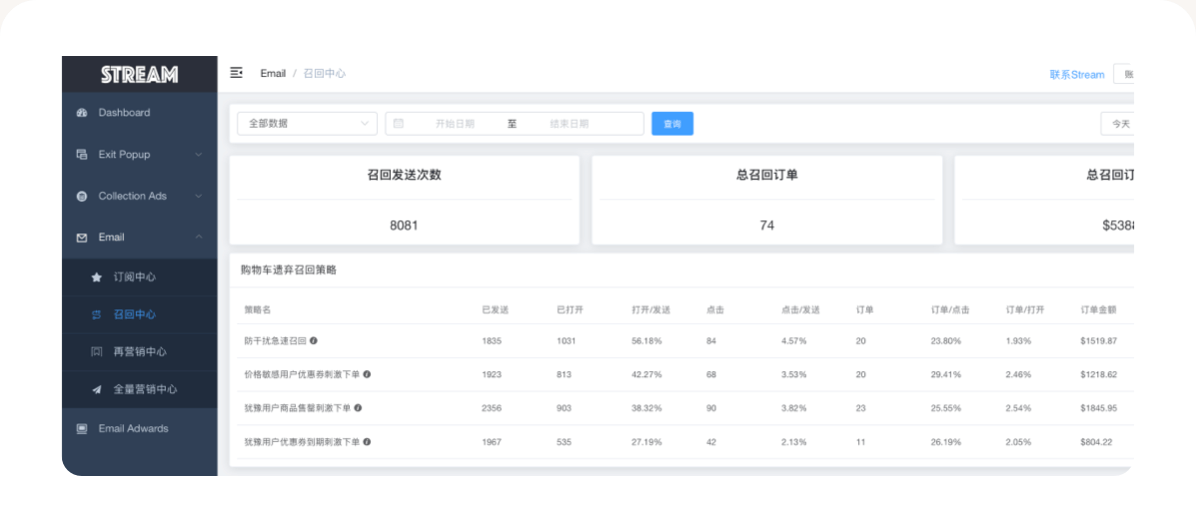
What Stream provides: 14 ready-to-run triggered strategies
Stream packages 14 core behavior-triggered email strategies that have been refined through repeated testing. The work includes subject lines, templates, copy, timing, and two deeper experience improvements.
1. Cart recovery across devices
A customer may see an ad at work and return on an iPad at home. When that customer clicks a Stream email, the page does not begin empty. Previously added or partially checked-out products can be restored even after the device changes.
2. Personalized destinations for product viewers
Customers who viewed products without adding them are still comparing options. Stream handles that journey by:
- Listing the products the customer viewed in the email
- Linking to a collection page rather than a single product page
- Ranking viewed products and relevant popular products at the top of that destination
In our tests, this approach increased average order value for this browse-without-cart segment by 20% to 30%. The result is an observed test range, not a guaranteed outcome for every store.
Together, Stream's subscription pop-up system and 14 triggered strategies create a practical conversion recovery system. The first job of email is then complete: capture more value from paid traffic that has already arrived.
The second layer: email becomes its own demand channel
In What core value does Stream deliver to ecommerce sellers?, we described two waves of traffic that email must support.
The first wave returns demand to where it came from. Before attention disappears, behavior-triggered email brings a customer back to the original purchase journey.
The second wave creates a new visit. When a subscriber is no longer actively returning, campaigns about products, promotions, and useful content can reactivate demand and create another opportunity to buy.
This leads to a second, often overlooked point: once a store sends campaigns consistently, email behaves like a small advertising system of its own.
Campaign clicks create new product views, carts, unfinished checkouts, completed purchases, and upsell opportunities. Those behaviors feed back into triggered recovery flows.
The full flywheel is:
Advertising creates the first demand -> Stream captures the subscriber and follows up on paid traffic -> the subscriber base receives campaigns -> triggered email follows up on campaign traffic -> the cycle repeats
That loop is the complete answer to maximizing conversion recovery.
Final thought
Stream is not another blank email tool that asks the seller to build every workflow from scratch. It turns seven years of accumulated email operations into productized starting points.
Sellers do not need to become email specialists before they begin. Stream is designed to help them establish a system that can keep operating while the team focuses on products, traffic, and the business itself.