Product value and solutions
Klaviyo Email Marketing: Which Revenue Model Fits Your Shopify Operation?
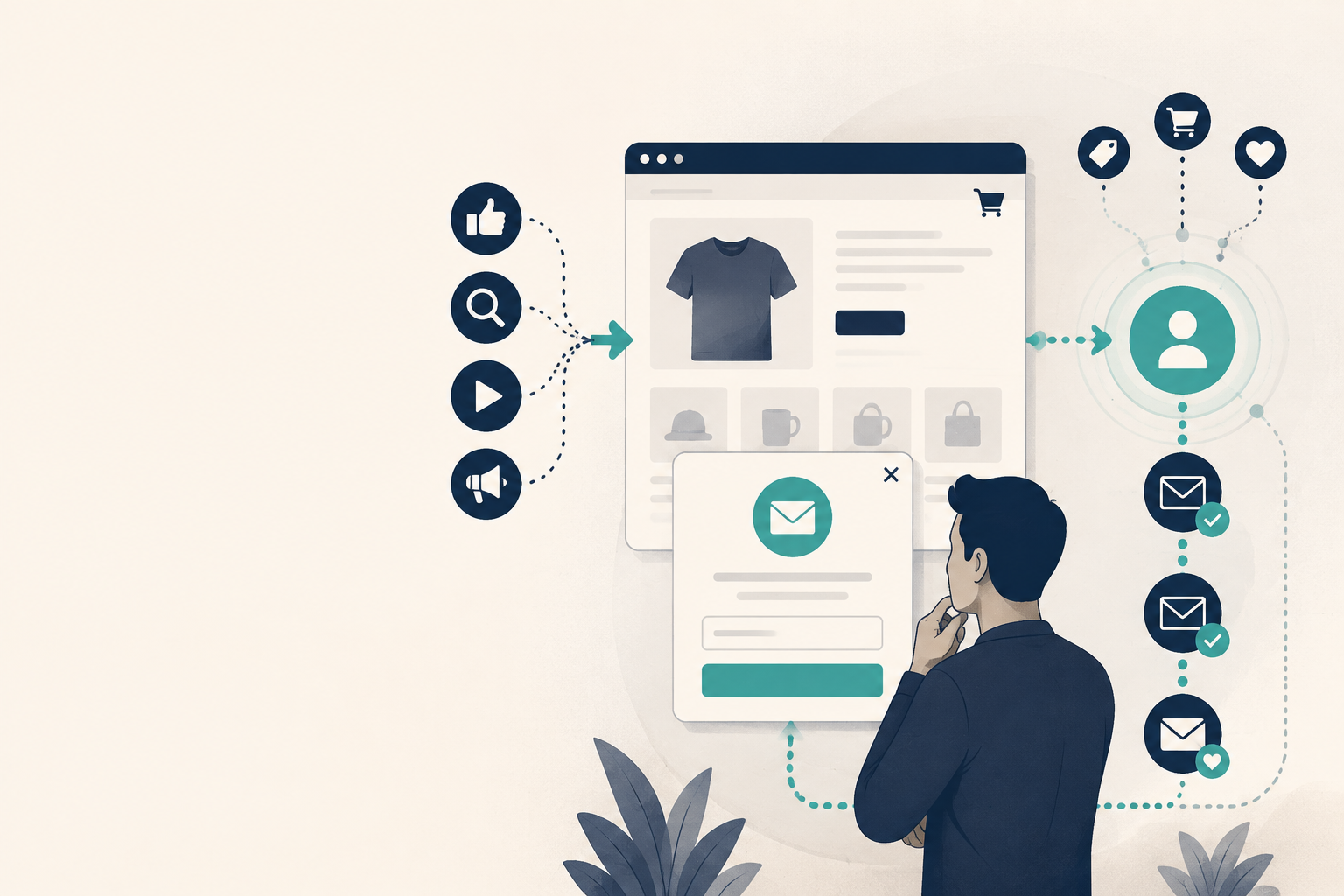
Klaviyo email marketing is not simply a choice between newsletters and automated messages. For a Shopify store, the more consequential decision is how much of the customer journey the platform needs to interpret: a subscriber joining a list
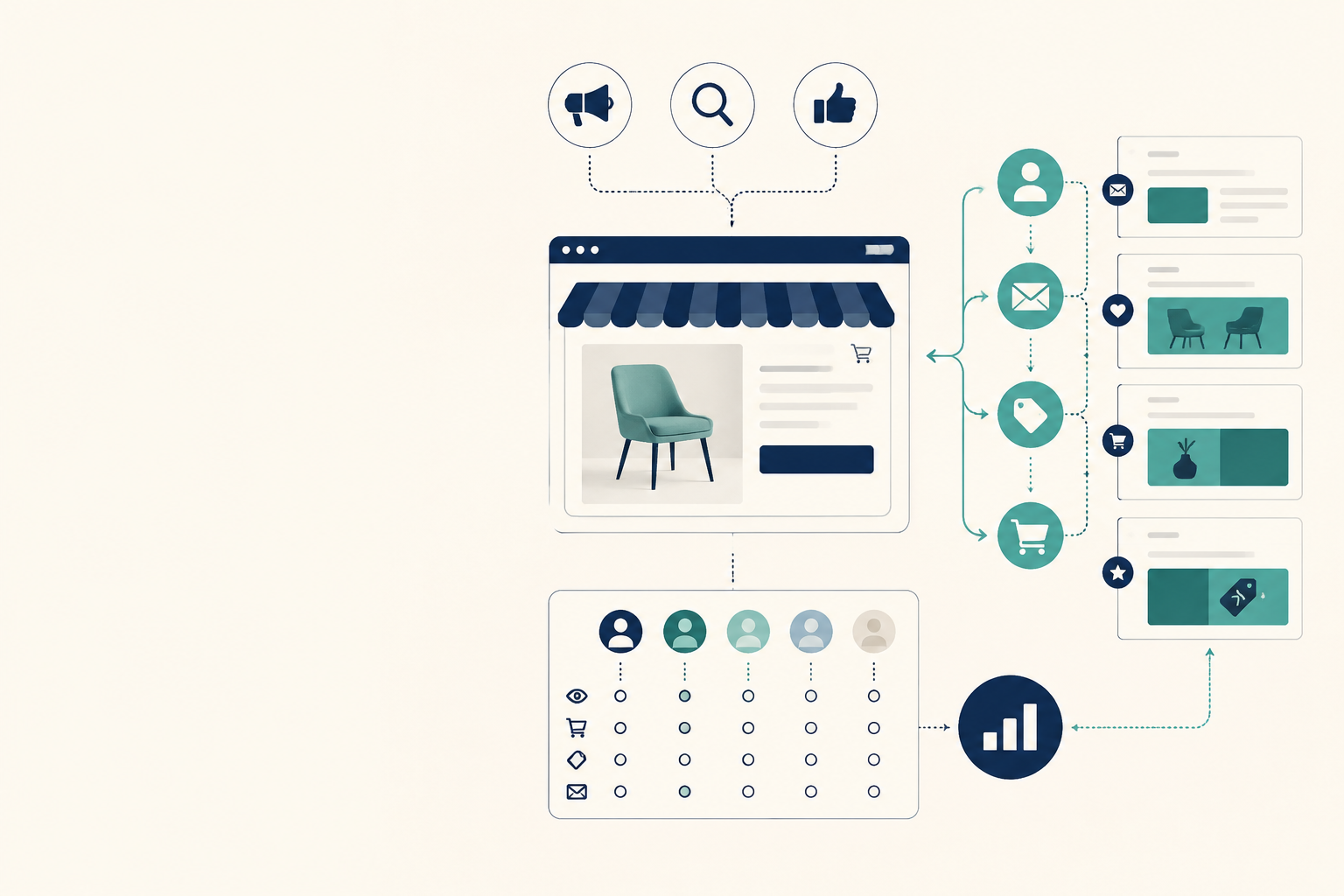
Klaviyo email marketing is not simply a choice between newsletters and automated messages. For a Shopify store, the more consequential decision is how much of the customer journey the platform needs to interpret: a subscriber joining a list, a checkout beginning, an order being placed, a product being viewed, or a customer becoming inactive.
Klaviyo is reported to serve roughly 176,000 ecommerce brands worldwide. [1] In a January 2026 report covering 11 managed brands, email-attributed revenue represented 33.7% of total store revenue, compared with an industry estimate of approximately 27%. Those figures describe one managed portfolio, not a universal outcome. The supplied report does not state the attribution window in its scorecard, so its platform-attributed revenue should not be compared with Shopify or advertising-platform orders until the rules and order overlap are reconciled. [2]
The useful question is not whether Klaviyo can send email. It is which combination of automation depth, Shopify data connectivity, channels, and billing structure matches the store's revenue model.
That decision follows four steps:
- Decide whether the operation needs broadcasts, behavioral automation, or both.
- Match the required automation, integrations, and pricing structure to that decision.
- Weigh the revenue and operating trade-offs across email, SMS, add-ons, and attribution.
- Verify the data, consent, pricing, and measurement conditions before committing budget.
The operator decision: broadcasts or behavioral automation?
Most independent Shopify stores begin with broadcast campaigns: a product announcement, seasonal promotion, weekly newsletter, or discount message sent to a selected list. The operating model is straightforward. A team chooses an audience, creates content, selects a send time, and reviews performance after delivery.
That model can be appropriate when the commercial objective is regular communication with a broad audience. It requires list management, content production, segmentation, and deliverability controls, but it does not require every customer event to become a trigger.
The decision changes when the store wants email to respond to what a customer does rather than what the marketing calendar says.
A checkout begins but no order is placed. A shopper views a product several times. A first-time buyer has not returned by the point at which repeat purchases usually occur. A customer who previously purchased becomes inactive.
These are not merely audience categories. They are events or sequences of events. A broadcast can include people who abandoned a cart, but it cannot naturally distinguish a recent high-intent checkout from a subscriber who has never visited the store. A behavioral flow can use the event as its entry condition, apply delays or conditional splits, and suppress the message when the customer places an order.
Klaviyo describes flows as automated sequences built around triggers, delays, and conditional paths. Common ecommerce applications include welcome, abandoned-cart, browse-abandonment, post-purchase, and win-back sequences. [3] Its Shopify data reference identifies events including Checkout Started, Placed Order, and Ordered Product, which provide the underlying signals for this type of automation. [4]
The economic distinction appears in recipient-level performance. In a January 2026 report covering 7.1 million emails sent by 11 managed brands, email flows generated $1.04 in platform-attributed revenue per recipient, while email campaigns generated $0.06. [2] The same report found flows produced between 2 and 75 times more revenue per recipient than campaigns across the brands in its portfolio. Its scorecard supplies recipient counts but does not state the attribution window, so the comparison describes the reporting system's revenue-per-recipient measure rather than incremental revenue. [2]
This is an observed portfolio result, not proof that installing flows will create the same lift for another store. The measurement grain is revenue per recipient, and the revenue is attributed within the reporting system used by the portfolio. It should not be read as incremental causal revenue.
The operating mechanism is nevertheless clear. Flows reach people after an observable action, while campaigns reach a selected audience at a scheduled time. The first model is more context-sensitive; the second is easier to plan and operate at scale.
A store considering Klaviyo should therefore ask:
- Which customer events have enough commercial value to justify an automated response?
- Can the store observe those events reliably?
- Is someone responsible for building, reviewing, and maintaining the flows?
- Will flow messages add enough relevant volume to change the plan tier?
- Can the store compare attributed email revenue with orders claimed by other channels?
If the answer is “not yet,” a simpler broadcast program may be the better operating choice. If the store already has meaningful checkout, product, and purchase volume, behavioral automation becomes a more credible investment hypothesis.
Solution shape: how the platform creates value
The solution shape has three parts:
- Automation depth: the customer moments the system can respond to.
- Integration mechanics: whether the necessary data reaches the system with the right timing and meaning.
- Pricing structure: how those capabilities are charged as sending volume, profiles, channels, and add-ons expand.
Automation depth
Klaviyo's flow builder supports behavioral triggers, time delays, conditional splits, and sequences. [3] In practical terms, a store can define a starting event, decide which customers qualify, wait for a specified period, and branch the journey according to a later event.
An abandoned-cart flow illustrates the logic. The entry event is a checkout or cart action. A delay creates a window in which the shopper may complete the purchase without intervention. A condition checks whether an order was placed. Customers who purchased should be excluded from subsequent recovery messages; those who did not may receive a reminder.
The same structure applies to a welcome series, although the trigger is subscription rather than checkout. A post-purchase flow begins with an order event and can distinguish first-time buyers from repeat customers. A win-back flow can use elapsed time or an engagement condition. The value is not the number of templates available. It is the ability to connect a message to a moment in the customer lifecycle.
MailMend reports an industry estimate of a 44.76% open rate for abandoned-cart emails and states that such emails recover 10-20% of lost purchases. [5] These are attributed commercial estimates. The supplied extract does not identify the cohort, reporting period, open-rate denominator, recovery window, or incremental-lift method, so the figures are planning references rather than store-level forecasts.
A practical interpretation is narrower: abandoned checkout is a high-value use case to test because it links a visible commercial event to a measurable order outcome. Before building the flow, the operator should define:
- the event that starts the flow;
- the event that stops or suppresses it;
- the time window for intervention;
- whether discounts are used;
- the order and revenue definition used for evaluation;
- how other channels will be treated in the final analysis.
The difference between a broadcast and a flow also changes measurement. A campaign's recipient pool is selected before sending. A flow's recipient pool is created by the trigger over time. Revenue per recipient can therefore be much higher for a flow even when its absolute send volume is much smaller.
Integration mechanics
Automation is only as meaningful as the data that enters it. Shopify's documented Klaviyo event references include checkout, order, and product events. [4] The Shopify App Store listing describes Klaviyo as syncing Shopify data in milliseconds and supporting customer, catalog, and event data. [6] That timing statement is a commercial platform description rather than an independent timing study, so a store should test actual event latency instead of assuming a fixed performance level.
The operating dependency is clear without relying on a precise sync-time claim. If Checkout Started is missing, delayed, duplicated, or associated with the wrong profile, an abandoned-cart flow cannot reliably distinguish an active checkout from a completed order. If Placed Order is not received, a reminder may continue after purchase. If product catalog data is incomplete, recommendations and product-specific messages may not reflect what the customer viewed or bought.
A Shopify connection therefore has two layers:
- Data availability: customer profiles, orders, catalog records, and behavioral events exist.
- Data usability: those records are mapped to the correct person, arrive within the relevant decision window, and can be used in triggers or exclusions.
Klaviyo lists more than 350 prebuilt integrations, and Shopify's summary describes their role as consolidating data from multiple sources for activation across Klaviyo's data, marketing, and service products. [1][6] That supports an integration-capacity claim, not a guarantee that any particular loyalty, review, support, or advertising system exposes the fields or triggers a store needs.
The operating decision is therefore connector-specific. Before including an external system in a lifecycle design, verify that the exact connector exists, identify the records and events it exposes, confirm update timing, and test whether those signals can be used in the intended trigger, condition, or exclusion.
The boundary is equally important. More integrations do not automatically produce better decisions. Each additional data source introduces mapping, consent, timing, and ownership questions. The platform can only act on signals that are available, correctly interpreted, and connected to a permitted communication purpose.
Pricing structure
Shopify's September 2025 summary describes three Klaviyo email marketing tiers. [1]
- Klaviyo Free: $0 per month, with up to 250 customer profiles and 500 monthly email sends. [1]
- Klaviyo Email: $20 per month for 5,000 monthly email sends and unlimited customer profiles. [1]
- Klaviyo Email + SMS: $20 per month for 5,000 monthly email sends and 150 monthly SMS credits. [1]
These figures are sourced from a commercial facilitator's summary and should be checked against Klaviyo's current price calculator before purchase. Pricing may vary with market, profile volume, send volume, and current commercial terms.
The free tier is useful for testing the interface, collecting an initial list, or sending at a very small volume. Its two separate limits-profiles and sends-create different breakpoints. A store can exceed the profile limit without sending frequently, or exceed the send limit with a relatively small list if it sends often.
The Email plan changes the structure by removing the stated profile cap while retaining send-volume pricing. Shopify's summary lists automated workflows, predictive analytics, product recommendations, and email deliverability scores among its features. [1]
For an operator, the claim that Email is the practical floor for an active operation should remain a hypothesis, not a product fact. The relevant test is whether the store's projected sends, profile count, and required workflows exceed the Free plan's boundaries. A near-term forecast should include scheduled campaigns, welcome messages, cart flows, post-purchase messages, and any re-engagement sequence.
The Email + SMS plan adds 150 SMS/MMS credits to the email allowance. The Shopify App Store listing separately describes an SMS option priced at $15 per 1,250 SMS/MMS credits, including carrier fees. [6] The exact account price and whether the option applies to a specific plan should be verified directly in the account's pricing view.
Klaviyo's broader product structure also includes paid add-ons described by Shopify:
- Klaviyo Analytics: $100 per month for businesses with up to 2,500 profiles, including cohort reports, behavioral pattern insights, and attribution modeling. [1]
- Klaviyo Data Platform: $500 per month for businesses with up to 100,000 profiles, including centralized profiles and no-code data transformations. [1]
- Klaviyo Service: free while in beta for Shopify stores, according to the cited September 2025 summary. [1]
- Klaviyo Reviews: starting at $25 per month for 250 monthly orders. [1]
These add-ons represent different operating problems. Analytics addresses interpretation and reporting. Data Platform addresses profile centralization and transformation. Service addresses customer interactions around purchase. Reviews addresses review collection and display. Treating them as a single “Klaviyo package” obscures the fact that each solves a different constraint.
Revenue-model trade-offs: what the configuration changes economically
The choice among plans is not only a feature comparison. It changes how the store pays for customer reach, how it values a message, and which kinds of revenue are visible in reporting.
Profile limits versus sending volume
The Free plan's 250-profile and 500-send limits make it suitable for small-scale experimentation, but the two limits constrain different operating patterns. A store can approach the send ceiling without approaching the profile ceiling when it communicates repeatedly with the same audience. Another store can reach the profile ceiling while sending infrequently. [1]
The Email plan's listed allowance of 5,000 monthly sends creates a different calculation. A store with a large list and occasional campaigns may use fewer sends than a smaller store running frequent campaigns and several active flows. The relevant unit is not simply the number of contacts stored. It is the relationship among profiles, campaign frequency, flow entry volume, and the number of messages each journey sends. [1]
This is why cost per send can be misleading. A flow that reaches a small, high-intent audience may produce more attributed revenue per recipient than a broad campaign, but it can also create additional send volume. A store that adds automation without accounting for those messages may move into a higher pricing bracket even while improving the relevance of its communication.
Email-only versus SMS
SMS changes both the cost structure and the consent workflow. The cited Klaviyo materials describe SMS credits as a separate allowance, while the Federal Trade Commission's CAN-SPAM guidance establishes requirements for commercial email, including identification and opt-out obligations. [1][7]
The operator should not assume that an email permission record automatically answers the question of whether SMS can be sent. Instead, verify which channel a customer consented to, where that permission is stored, how it can be withdrawn, and which markets' requirements apply. The responsibility for consent ownership should be clear before an SMS flow is activated.
In the January 2026 scorecard covering 7.1 million emails from 11 managed brands, email flows had a 0.60% unsubscribe rate, compared with 0.18% for email campaigns. [2] Both figures concern email message types, not an email-versus-SMS comparison. The supplied extract does not define the unsubscribe-rate denominator, so the figures should be compared only within that portfolio and reporting period.
SMS therefore needs a separate business case. It can fit flash sales, restock alerts, and other time-sensitive messages, but its value depends on channel-specific consent, urgency, margin, frequency, and customer tolerance rather than on the email portfolio's performance.
Monthly SMS credit allowances add another economic constraint. A store with irregular promotional demand should verify the current account's rollover, expiration, and overage terms instead of assuming unused credits carry forward or expire. The Email + SMS plan therefore fits a revenue model with recurring, permissioned mobile use better than one that only sends occasional text promotions.
Add-ons versus a modular stack
Analytics and data products change the cost question from “How many emails will we send?” to “Where will customer and revenue analysis live?”
Klaviyo Analytics is listed at $100 per month for up to 2,500 profiles, while the Data Platform is listed at $500 per month for up to 100,000 profiles. [1] The difference is not merely a higher reporting tier. Analytics concerns cohorts, behavioral patterns, dashboards, and attribution. Data Platform concerns the centralization and transformation of profile data.
A store that already has dependable reporting may find that an additional analytics product duplicates existing work. A store whose documented customer, order, catalog, and behavioral records remain fragmented may value centralization more than another campaign report. The correct comparison is therefore between operating problems, not between feature counts.
Reviews creates a similar trade-off. Klaviyo Reviews is listed at $25 per month for 250 monthly orders. [1] Its value depends on whether consolidating review requests with lifecycle messaging reduces enough operational friction to justify the added cost. The supplied research does not establish a universal cost or performance advantage for a consolidated review setup.
Benchmarks versus revenue
Klaviyo's published industry estimates report average campaign open rates of 37.93% and flow open rates of 48.57%. Campaign click rates average 1.29%, while flow click rates average 4.67%. [8][2] These are industry estimates associated with Klaviyo's benchmark material, not a neutral market census. The supplied extract does not identify the benchmark cohort, period, or delivered-message denominator, so an operator should compare them only with the current account's matching metric definitions.
A January 2026 managed portfolio covering 11 brands and 7.1 million email recipients illustrates why rate metrics need context. Email campaigns produced a 49.58% open rate but a 0.53% click rate in the report's message-level scorecard. [2] The extract does not define the delivered-message denominator or attribution window. The portfolio operator says it deliberately sent campaigns to broader audiences, accepting a lower click rate in pursuit of total revenue; its platform-attributed email revenue represented 33.7% of total store revenue, compared with the report's industry estimate of approximately 27%. [2]
The observation is not that low click rates are desirable. It is that optimization targets can conflict. Narrower segmentation may increase clicks per recipient while reducing total reachable customers. Broader distribution may increase total attributed revenue while weakening rate metrics. The relevant boundary is the store's objective and measurement grain: click rate is measured per recipient or delivered message, while revenue is measured at the order or attributed-revenue level.
Apple Mail Privacy Protection further weakens the meaning of open rates. MailMend estimates that Apple privacy protections have inflated reported opens by 5-10 percentage points since 2021 and affect 64% of Apple Mail users. [9] Clicks and placed orders require stronger customer action than an email open signal, so they provide a more useful basis for evaluating content and commercial response.
Segmentation also changes the relationship between reach and engagement. MailMend reports industry estimates that segmented campaigns generate 30% more opens and 50% more clicks than unsegmented campaigns. [5] Those figures do not determine the right number of segments for every store. They show why segmentation is an economic trade-off: more relevance may improve response, but each additional segment creates work in data definition, creative variation, testing, and maintenance.
Cart recovery as an investment hypothesis
The cart-recovery calculation demonstrates why a paid email plan can become economically rational before a store needs advanced analytics or SMS.
MailMend cites an estimated 10-20% recovery range for abandoned-cart emails. [5] This is a commercial industry estimate; the supplied extract does not state its cohort, reporting period, attribution window, or whether the denominator is all initiated checkouts or only reachable recipients. A store should begin with its own observed initiated-checkout count and average order value, then model a labeled scenario without presenting the result as guaranteed lift.
The planning model should multiply the store's observed abandoned-cart count by a clearly labeled recovery assumption, then multiply the resulting potential orders by observed average order value. The output is modeled attributed revenue before discounts, refunds, margin, and cross-channel overlap are considered.
That calculation is a scenario, not evidence of causal lift. Its usefulness is that it forces the operator to identify the required inputs:
- observed abandoned-cart volume;
- average order value;
- the recovery assumption and its source;
- discount and margin effects;
- the attribution window;
- orders also claimed by paid advertising or other channels.
The $20 Email plan listed by Shopify may appear small relative to such a scenario, but that comparison is only meaningful after the store verifies plan pricing and tests whether the flow generates incremental or merely platform-attributed orders. [1][2][5]
Pre-buy verification checklist
Before committing budget to a Klaviyo plan or add-on, run the following checks. The goal is not to confirm that the interface works in general. It is to verify that the specific Shopify operation can support the intended revenue model.
1. Run a live Checkout Started test
Create a controlled checkout and confirm that Checkout Started appears on the expected profile with the relevant cart or product details. [4] Record the event time and the time it becomes available for flow logic.
Do not build an abandoned-cart program until this test passes. A connection that is installed but does not reliably capture the trigger is not an operational integration.
2. Verify Placed Order suppression
Complete the test order and confirm that Placed Order is recorded. [4] Then verify that the abandoned-cart flow excludes or suppresses the purchaser.
This is a separate test from receiving Checkout Started. The first confirms entry into the journey; the second confirms that the journey can recognize the commercial outcome and stop treating the customer as an open opportunity.
3. Forecast profiles and sends
Use observed profile growth and planned activity to build a near-term forecast. Include:
- existing and expected customer profiles;
- scheduled campaigns;
- welcome messages;
- cart and browse flows;
- post-purchase messages;
- any re-engagement activity;
- expected SMS usage, if relevant.
Compare the forecast with the listed Free limits of 250 profiles and 500 monthly email sends, and with the Email and Email + SMS allowances described by Shopify. [1] Treat the conclusion that a paid Email plan is necessary as an operator hypothesis supported by the forecast, not as a universal product rule.
4. Authenticate the sending domain
Set up and verify SPF, DKIM, and DMARC before sending campaigns. Klaviyo setup guidance identifies domain authentication through DNS records as part of sending configuration. [10] Verify the published DNS records using the documented setup flow and an independent DNS lookup, then record which domain is sending, who controls its DNS, and when changes were made.
If performance is weak after launch, authentication should be checked before content changes are treated as the primary remedy. Commercial estimates about the size of inbox-placement losses vary, so do not use an unsupported percentage as a forecast for your store. [9]
5. Confirm consent ownership by channel
Document where email and SMS permissions are collected, what wording customers see, how permissions are passed into Klaviyo, and how unsubscribes are processed. The FTC's CAN-SPAM guidance sets requirements for commercial email, including identification and opt-out provisions. [7]
For SMS, verify the applicable requirements for each market and make sure the store can distinguish channel permissions rather than treating one general subscriber status as permission for every message type. The relevant pre-buy question is operational ownership: who reviews consent, who handles opt-outs, and who pauses a flow when permission data is uncertain?
6. Verify add-on pricing and eligibility
Check current account-specific pricing for Analytics, Data Platform, Service, Reviews, and any SMS credit package. Shopify's cited summary lists Analytics at $100 per month for up to 2,500 profiles, Data Platform at $500 per month for up to 100,000 profiles, and Reviews starting at $25 per month for 250 monthly orders. [1]
Treat those figures as a starting point for budget planning, not a guaranteed invoice. Confirm the market, profile band, order band, credit allowance, renewal terms, and whether the feature is included in the plan being evaluated.
7. Reconcile Klaviyo revenue with Shopify orders
Export a defined period of Klaviyo-attributed orders and compare them with Shopify orders for the same period. Record the measurement grain, attribution window, order-status treatment, refunds, discounts, and channel interactions.
The January 2026 benchmark report describes platform-attributed revenue from campaigns and flows. [2] Before using that revenue to justify budget, verify the report's attribution rules and compare the same orders with advertising-platform claims. An order appearing in both systems is not automatically two orders or proof of incremental email revenue.
8. Define inactivity using observable business signals
Do not use a fixed inactivity threshold without deciding what “inactive” means for the store. The relevant signal may be no recorded click, no purchase, no site activity, or a combination of events. Open-only definitions require caution because Apple Mail Privacy Protection affects reported opens. [9]
The store should choose a definition that matches its buying cycle and then test whether the resulting segment behaves as expected. A customer who has not opened an email but has recently purchased should not be treated the same way as a customer with no recent purchase, click, or site activity.
9. Test migration assumptions with a small cohort
If moving from another email platform, validate which subscriber fields, consent records, campaign history, segment conditions, and automation logic can be transferred. The supplied setup material describes importing contact lists and rebuilding core setup steps, but it does not establish a universal migration limitation or a fixed number of hours for rebuilding a program. [10]
Use a small test cohort before migrating the full database. Compare profile counts, consent status, key properties, suppression behavior, and segment membership after import.
The decision in context
Klaviyo email marketing fits most clearly when a Shopify store's revenue model depends on lifecycle moments that broadcasts cannot represent: checkout recovery, first-purchase follow-up, product or browse intent, and re-engagement. Its value comes from connecting those moments to messages, not from sending a larger number of newsletters.
The Free plan is a testing environment bounded by the listed limits of 250 profiles and 500 monthly sends. The listed $20 Email plan becomes a reasonable hypothesis when the store's forecast exceeds those limits or when the operation needs the paid-plan capabilities described by Shopify. Email + SMS adds a separate channel whose value depends on consent, urgency, usage regularity, and unsubscribe tolerance. Analytics, Data, Service, and Reviews address different operating problems and should be evaluated as separate additions rather than assumed components of email marketing. [1]
For Stream Insights readers, the central diagnostic is whether advertising traffic, onsite behavior, customer events, and lifecycle follow-up are being interpreted together. If those signals remain isolated, a Klaviyo flow may receive only part of the context needed to explain why a customer converted-or why an apparently successful email received credit for an order influenced by several channels.
Start by reconciling one flow's platform-attributed orders with the corresponding Shopify orders and advertising-platform claims under an agreed measurement rule. If that cross-channel diagnosis is difficult to perform internally, Stream Insights can help structure the evaluation without treating Klaviyo-attributed revenue as proof of incremental lift.
Sources
- What Is Klaviyo? Core Features, Pricing, and Shopify Details (2026) - shopify.com
- E-Commerce Email Marketing Benchmarks - January 2026 | BS&Co - bsandco.us
- Automated Email Flows for Smarter Drip Campaigns - Klaviyo UK - klaviyo.com
- Shopify data reference | Klaviyo Help Center - help.klaviyo.com
- 28 E-commerce Email Benchmarks Statistics - Mailmend - mailmend.io
- Klaviyo: Email Marketing & SMS - Shopify App Store - apps.shopify.com
- CAN-SPAM Act: A Compliance Guide for Business - ftc.gov
- 2026 Email Marketing Benchmarks by Industry - Klaviyo - klaviyo.com
- Why Is My Open Rate So Low on Klaviyo and Could It ... - Mailmend - mailmend.io
- Klaviyo Tutorial: Guide to Starting your Ecommerce Email Marketing - emailtooltester.com