Store growth should not start with more tools
Sustainable growth comes from connecting visits, subscriptions, win-back flows, and repeat purchases into one operating system.

Why more tools can make growth harder
Ecommerce seller teams often start by choosing separate tools for pop-ups, email, customer analytics, and reviews. Each tool solves a local problem. Once data and actions are split across systems, however, the team has to export audiences, rebuild tags, and repeatedly check trigger logic.
The tools may be running, but the growth system is not.
A growth system is defined by how well the core actions connect:
- Visitors share an email address at a relevant moment.
- Browse, cart, and purchase activity become one customer journey.
- The system selects the next message from the latest behavior.
- Every open, click, and purchase updates what happens next.
A loop that keeps working is more valuable than a collection of advanced features that operate in isolation.
Review the system at four points
Do opt-in prompts follow shopping intent?
A homepage pop-up is only one subscription opportunity. Intent changes when a visitor views several products, adds an item to the cart, or prepares to leave. The opt-in invitation should change with it.
Good subscription design answers two questions: why the visitor should share an email address now, and what they will receive in return.
Can customer behavior be read as one journey?
When browsing, cart, and purchase activity live in different tools, the team cannot reliably tell where a customer is in the journey. A unified behavior history prevents recent buyers from receiving cart recovery messages and makes repeat purchase content more relevant.
Does automation learn from the result?
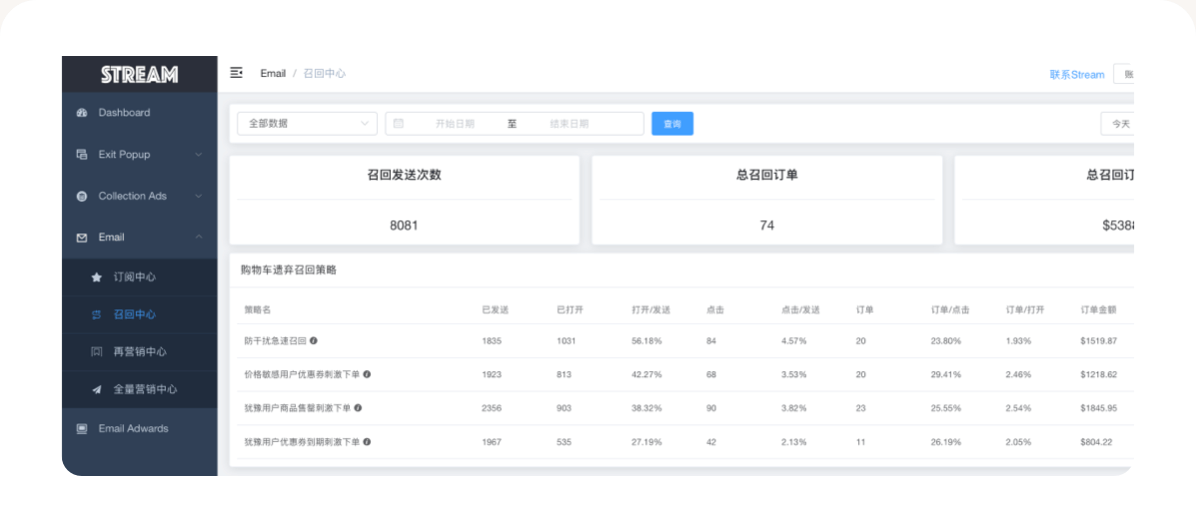
Traditional workflows often stop after the send. A complete loop continues to read opens, clicks, purchases, and inactivity, then adjusts the content and timing of the next message.
Can the team maintain it quickly?
Growth strategies need to operate for the long term. If every adjustment requires developers, complex fields, or manual lists, the system will become stale. A ready-to-run strategy should provide a clear default while preserving the controls that matter.
Start with the smallest complete loop
You do not need to launch every strategy at once. Begin with a minimum operating loop:
| Stage | Action |
|---|---|
| Subscribe | Cover the homepage, browsing, and cart touchpoints |
| Identify | Connect the subscription to later shopping behavior |
| Win back | Enable core welcome, browse, and cart automations |
| Review | Check subscription, click, and purchase results weekly |
Once these four parts operate reliably, add repeat purchase, inactive customer, and review invitation strategies. Each extension will have a clear input and outcome, instead of becoming another workflow that the team has to maintain.
Turn strategy into a default capability
Ready-to-run does not mean enabling every switch by default. It means turning tested strategies, trigger logic, and content structures into a dependable starting point.
The team can launch with the default system, then refine it around category, average order value, and purchase cycle. Growth knowledge no longer lives with one operator. It becomes a capability the system keeps providing.